
Pulling Threads
Fraud, fraud, and more fraud - what unravels when you stop doomscrolling and start digging.


Welcome to this month’s long-form edition of The Integrity Gap. For new subscribers, the general format is:
What We’re Seeing - 3 trends or emerging risks
Intel - 1 case study
Tools & Resources - 1 practical framework or idea
What’s Next - forward-looking insight
What we’re seeing
Fraud, fraud, and more fraud.
According to the WSJ, fraudsters in Russia have a grim new scam - marrying soldiers fighting in Ukraine. “It’s very easy,” an estate agent in Siberia told a podcast earlier this year. “Find a guy serving on the front, and when he dies, you get eight million. It’s a business plan.” Where there is money/incentives, there will be fraud. That’s why we need to think carefully about what we reward and how.
An Aussie startup promises to use AI to prevent fraud. Apate creates bots that imitate victims and waste scammers’ time. Not new, UK telecom firm O2 created Daisy (an AI granny) to do the same, as part of a campaign to socialise a hotline. I can’t yet decide how I feel about these services - it feels like we haven’t considered the next step in the escalating war.
Tax fraud whistleblowers in the UK could receive millions under a new incentive scheme. If implemented properly, I can get behind the idea. Whistleblowers usually suffer significantly. Some might argue we can’t create a culture where we must reward people for doing the right thing. But most who argue that have never been an investigator into whistleblower allegations. Across the few hundred investigations/assessments I’ve been involved in, I’ve seen whistleblowers murdered, assaulted, stalked, harassed, and hounded to the point of suicide. It is much more common than column inches would suggest, as we move on from the story once it’s broken. The retaliation comes later.
Case study: Learning by doing
For the past year or so, I’ve been working with (partnering) a fractional head of AI. For some, this act is sacrilege. “AI slop, AI will kill jobs, AI is ruining our brains.” I agree. It’s a tool. Used incorrectly, any tool becomes dangerous. I also agree that we’ve created a tool, much like atomic energy, which could have catastrophic and (un)foreseen consequences.
But it’s also here. Pretending it isn’t is lunacy for anyone in a job that involves striking a keyboard and swishing mice. We need to understand what we’re up against.
Last Sunday, as the Epstein rot subsumed my feed, I found myself getting furious. Sat, in an armchair, by a fire, dog on lap, doomscrolling, stewing. Not good, pathetic. I’ve stayed in this line of work for a quarter of a century because I don’t like the baddies winning. As self-awareness kicked back in and the serenity prayer OS crept back into my brain, I considered “What is within my control?”
“God, grant me the serenity to accept the things I cannot change, the courage to change the things I can, and the wisdom to know the difference.”
Well, our local council are a rolling horror-show of overspending, dodgy dealing, and unaccountability. Why not start there? They have a daily impact on our family. I started creating the schema (architectural plan and scaffolding), knowledge base (building materials), and prompting kit (making sure the right bits of kit go together in the proper order) for a custom agent/assistant.
A year ago, I wouldn’t have known where to start. In about four hours, I had the skeleton together. Over this weekend, I will chip away again. What will the agent do? Measure the progressively thinner public disclosures that our council is obligated to publish against the regulations they’re meant to follow. Surface gaps and rank them using a rubric (another AI term) that, after much tweaking, now understands the difference between noise, smoke, and fire.
Will it go anywhere, or get any traction? Who knows. But I live two doors down from a retired chemistry teacher who seems to have made it her post-work life’s mission to be in everyone’s business. I might just set this increasingly tech-savvy force of nature loose on my creation.
Whatever happens, it felt good to start pulling the thread. If you’re also feeling that “WTF, we’re ruled by totally unaccountable (enablers of/partakers in) child abuse, driving people to suicide, swilling in endemic corruption, and probably also murder,” start pulling the threads. The time for sitting on the sidelines hand-ringing is long gone.
Tools and resources: How to spot a knobhead founder
It won’t come as news that many successful founders are tyrannical knobheads (hoping the UK vernacular passes your spam filter). Sometimes, as an investor, you might live with that, as they’re just soooo brilliant.
I don’t think that’s necessary. You might not wish to cast aside someone who may have been instrumental in the organisation’s success. Fair enough. But don’t leave them managing people or leading. Knobheads probably don’t much like people - they’re annoying, feel things, and have needs. So, keep them doing what they’re good at - product, promotion, perfection (normally). Set up governance that flatters their ego while insulating others.
But how do you spot a nascent or blooming bell-end?
I recently worked on a deal where an operational team were excelling in an e-mobility expansion. Then the founder joined the meeting. The heads went down, cameras off, disgust and contempt micro-expressions popped up, and discourse died. It might not always be so evident, but a few questions that help calibrate the bell-end-o-meter:
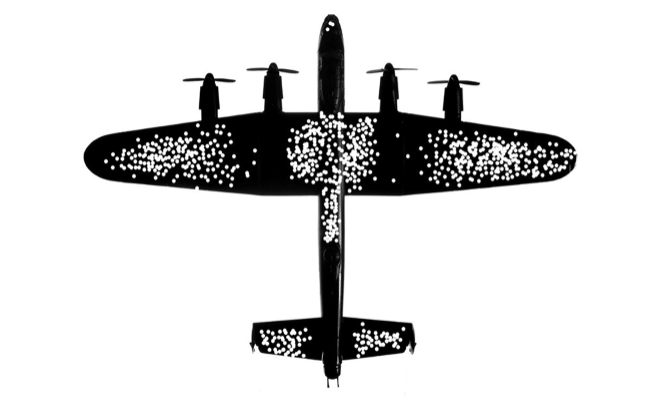
For the “we have a great culture, and my door is always open” knobhead: “Great, when was the last time someone came through that door?” Here, we’re looking at the Abraham Wald paradox: in WWII, US bombers suffered high casualties, so they started mapping the holes in returning aircraft (image below). The plan was to strengthen the damaged areas until Wald pointed out that these were the returning aeroplanes; damage to the unmarked areas was likely more fatal. Who doesn’t walk through the founder’s door, or what issues are never surfaced, tells you most.
When dealing with a superhero (they claim to do everything), channel your inner tax inspector. Go keep on technical questions, use the most detail-oriented people in your team (advisors) for the due diligence. Once you get their wheels spinning, see who they delegate to. That’s your cadre of leaders.
If you’re finding that only one or two people speak in every meeting, don’t try to coax the silent into open discussion. Sometimes, you might not even want to suggest one-on-ones (that could also place them in jeopardy). Instead, as the lord or lady holds court, they will inevitably say some stuff that elicits fear micros, grimaces, elevated blink rates, downward stares, or other indicators of stress from their team. Follow up by simply mirroring their words. “We always do X or Y...”, “Always?”
What’s Next?
It’s not new, but it’s worth remembering that knowledge is power, but information is now asymmetric.
Polymarket now tells us of geopolitical moves: the $400k wager that Maduro would be removed; Machado’s Nobel peace prize; and Israel’s strikes on Iran, were all ‘picked’ before they happened.
Coding and conference sites are now routinely stalked by those looking to understand who is building what. As our partners at Neon Century (OSINT ninjas) recently put it: “Every GitHub commit reveals product direction. Every conference appearance signals market positioning. Social media interactions expose strategic partnerships before they’re announced.”
Even dips in Grindr usage and surges in food deliveries around the Pentagon presaged recent military actions.
If your job is to manage risk or foresee what’s next, it’s time to start looking at how we use technology, when we do or don’t use it, and where.
Quote of the month
Everything we hear is an opinion, not a fact. Everything we see is a perspective, not the truth.
Marcus Aurelius