
Lying, deception, misleading, withholding, omitting... where do we draw the line on truthfulness?
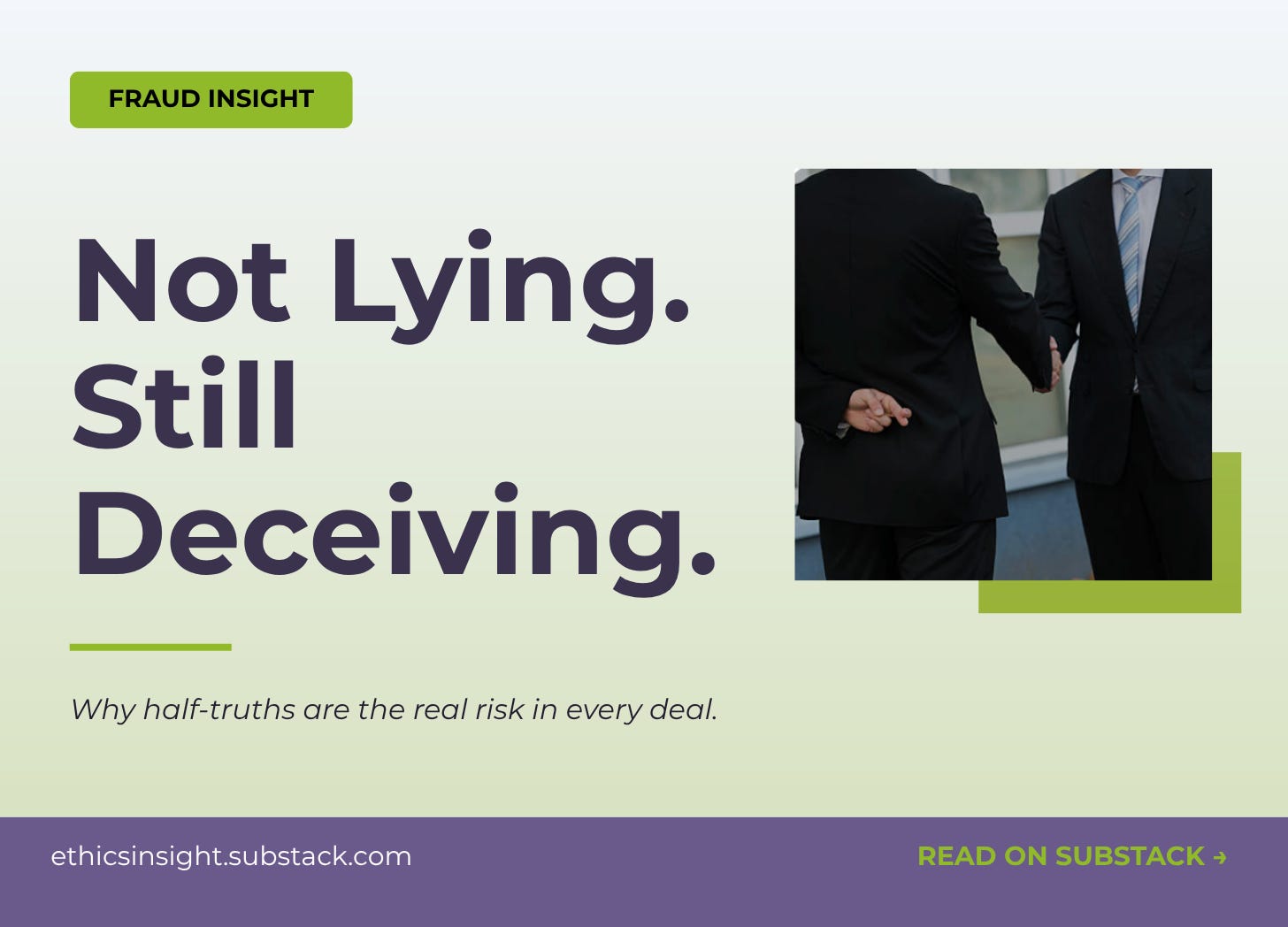
The art of not quite lying, and why it can be lethal in businesses, boardrooms, and deal teams.

This week, the UK’s beleaguered prime minister faced a testy exchange with opposition members of parliament when defending his decision to hire trouser-phobic, Epstein buddy, and self-styled ‘Prince of Darkness’, Peter Mandelson. Two members were removed from the chamber for accusing the PM of lying as he plunged deeper into his ‘I don’t know anything anymore’ defence.
Deception at work
My role is to walk a knife-edge between collaboration and gentle confrontation (detecting risks, gaps, deception). I am in the room to help the investor surface potential issues associated with a proposed investment. Often, our role is forward-looking - if the investee receives a multi-million $/£/€ injection, are they ready to manage the risks associated with that capital deployment (new markets, products, expansion, Capex, research, etc.)? In other words, are there indicators of structural (controls), contextual (inherent risk), or behavioural (decision-making) vulnerabilities?
On that last point, deception and transparency are critical judgment factors.
Removing room for deception
The Mandelson allegations were levelled at the PM, following his supposed dodging (refusing to answer or sidestepping) 23 of the last 24 questions he’d been asked during the Prime Minister’s Questions (a weekly chance for the opposition to grill the government).
I have to deal with this, too. Outright lies are less common in my work because I don’t work with politicians we lead with evidence. We request and review the policies and procedures ahead of any meeting. That way, we can reduce the space for lies, “I understand you answered ‘yes’ to the question ‘Do you conduct risk assessments?’ but didn’t provide a copy. Are you able to share a copy now or walk me through the process?” In that context, lying becomes much harder.
But what is lying?
Dictionary definitions of “lying” or “lie” are not our friend, ranging from “the act of uttering or conveying falsehoods,” or “to say or write something that you know is not true,” or “a statement made by somebody knowing that it is not true.”
These are quite bad definitions from the perspective of those of us trying to get to the truth. “The act of uttering...” means what exactly? Would convey, say, write, state (all active) cover withholding the truth (more passive)? Take these examples and see how they fit (or not) those definitions:
Avoiding answering (deflecting, dodging, rambling incoherently, pleading the fifth).
Omitting critical information while conveying an otherwise truthful account.
Pretending not to understand.
Playing semantics (e.g., “I didn’t realise prohibited payments to public officials extend to the state energy company”).
I’ve seen these forms of deception (and more) much more regularly than neatly packaged outright fabrications (entirely false statements).
A better definition
The people who trained me on deception detection and behavioural analysis use this definition: “a deliberate attempt to mislead without giving prior notification.” Prior notification covers off areas where we are knowingly and willingly deceived (magicians, movies, tooth fairy, etc.). I like the phrasing deliberate attempt, as it shifts the focus to intent. In this context, withholding, dodging, confusing, etc., are all intentional acts of deception.
Why does this matter?
White lies and social niceties will remain. Who answers “How’s your week going?” honestly in a work context!? And how many of us believe “I hope this email finds you well” to always be sincere (video source: corporateofficebs).
But deliberate misleading, for those of us working in risk, investigations, and due diligence, is a HUGE area, and one we’re calibrating poorly (in my experience).
Intentional deception is a red flag. We’d note as much if disclosure doesn’t match public documents. So why do we sometimes go easy in interpersonal interactions (investigations, training, monitoring, due diligence)? If you’re concerned about calibrating truth and lies accurately, that’s a wise reflex. The data suggests most people detect deception at a not-better-than-chance level (~50%). But, with a bit of training, we move up to 70%-80%, and with a lot of training, a few will reach over 90%.
What to do instead
For your high-stakes decisions, have a 90+% person in the room. Deceiving with data (disclosures, hidden owners, etc.) is certainly worth considering, but in my experience, the deals that went most wrong had clean paper trails. It was the interactions with the management that were peppered with deception (and too often discounted with disastrous outcomes).
As AI subsumes much of the data diagnostics, we humans need to upskill to become the value-adding deception detection and decision-making human readers. Suggesting someone is lying, with overwhelming evidence, should not get you kicked out of parliament, nor should it be ignored in a deal team or board room.
Would you agree?